

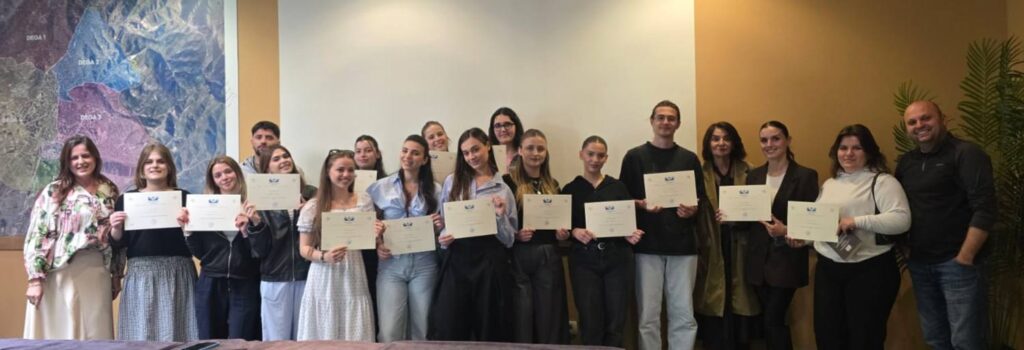
The Journalism Ethics School, organized by the Kosovo Press Council (KPC), has concluded in Pristina.
The first day of the second module of the school discussed defamation and insult, media education, and the safety of journalists.
Flutura Kusari, a media law lawyer, spoke with journalism students and young journalists about freedom of expression and the Civil Law against Defamation and Insult. Through concrete examples, she explained issues related to ethical reporting and respect for codes of ethics and the law.
Blerta Dibrani, a lecturer at the Department of Journalism at the University of Prishtina (UP), spoke about the importance of media education. She also presented the results of a survey conducted with young people throughout Kosovo, through which their perceptions regarding the consumption of media content and sources of information were measured.
Meanwhile, in the third session, Xhemajl Rexha, President of the Association of Journalists of Kosovo (AJK), spoke about the safety of journalists in Kosovo and the care that the media should show for journalists when reporting in crisis situations. He also mentioned concrete cases from his work in crisis regions, in the function of ethical and professional reporting.
On the second day the participants visited the online media outlet Telegrafi and the Information and Privacy Agency (IPA).
At Telegrafi, with Editor-in-Chief Muhamet Hajrullahu, the students and young journalists talked about work in the editorial office, the daily practical work of journalists in the field, as well as the functioning of a media outlet.
Hajrullahu explained the organization of work in the editorial office, including the daily news, but also the production of many other products of Telegrafi.com. He also emphasized the importance of respecting the PCK Code of Ethics in order to ensure fair and professional reporting.
At the Information and Privacy Agency (IPA), the participants of the School of Ethics had the opportunity to talk with the IPA Commissioner, Krenare Sogojeva-Dërmaku,and the General Director, Lumnije Demi.
The meeting emphasized the role of the IPA in handling complaints about access to public documents and the protection of personal data, ensuring that every individual has the right to access information, according to the legislation in force.
The Commissioner encouraged the students to follow the principles of ethics in their work and to commit to responsible journalism, which is in the service of fair and accurate information to the public, while respecting the privacy and rights of citizens.
During the meeting, the challenges faced by journalists in the era of rapid information, as well as the importance of protecting citizens' personal data in ensuring the integrity of public information, were also discussed.
On the third and last day of the school the participating students and young journalists spoke with media professionals about documenting history through journalism, and methods and tools for deconstructing false media content.
Visar Duriqi from Gazeta Insajderi spoke with journalism students and young journalists about documenting history through journalism, namely how to turn an investigative file into an investigative narrative.
He spoke about his research experiences while reporting on sensitive topics, with a special emphasis on criminal cases, as well as about the process of writing his book about the “Bllaca Case”.
Fatbardh Dema and Etrit Rexhepi from Hibrid.info spoke about information distortion and false media content. Through concrete examples they demonstrated the ways, methods and tools of deconstructing this kind of content, offering opportunities for students and young journalists to use them in their daily work.
This edition of the School of Journalism Ethics is organized with the support of UNESCO within the framework of the project “Building Trust in the Media in South-Eastern Europe: Supporting Journalism as a Public Good”, funded by the European Union.
Add Comment